NOTE: Imtra will not be shipping orders until September 8, 2026. Our team remains available to assist you. Please contact us by phone at 508-995-7000 for assistance.
Sign in to like and rate
Whether your boat is 26 feet or 10 times that, choosing the right anchor windlass to handle your anchor-hauling duties requires similar steps. There are many types and brands of windlasses on the market, and many of them can do a good job for you. This post will explore what a windlass is and some of the key factors to assess before making a purchase.
What is an Anchor Windlass?
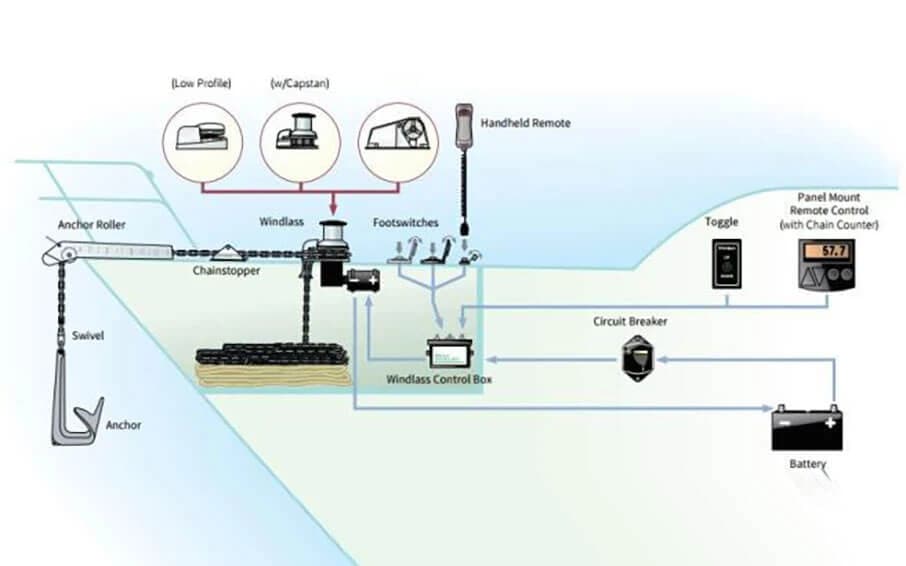
An anchor windlass is a device that is mounted on the foredeck of a boat that uses electric, hydraulic, or manual power to raise and lower the anchor and anchor rode (chain or rope).
Marine Deck Machinery: Windlass, Winch, and Capstan Explained
How to Select an Anchor Windlass: Key Considerations
Explore some key factors and questions to consider when picking the best windlass for your boat.
Evaluate Your Current Windlass
If your previous windlass worked well but wore out, you may have a simple decision to replace it with a similar model. But if it broke, or if you were dissatisfied with its performance, you should consider how another model or style might fit your boat better, or if the windlass was up to spec given the loads put on it.
Consider Windlass Power Source Options
Picking the right winch power source is one of the most important aspects to think about when choosing an anchor windlass, as it will determine the windlass’s efficiency, ease of use, and compatibility with your boat’s existing systems. Consider each of these three core power sources:
Horizontal or Vertical Windlass: What’s Right for You?
Choosing between a horizontal and vertical windlass depends on your boat’s deck space, anchor locker depth, and rode type. Each design has its advantages and limitations, so understanding how they function can help you determine the best fit for your setup.
If you already have a windlass and are not sure which type you have, remember that the terms horizontal and vertical refer to the orientation of the shaft of the windlass. Another way of telling is to look at the chain wheel on the windlass. If it spins like a merry-go-round, it’s vertical; if it turns like a Ferris wheel, it’s horizontal.
If you are replacing a windlass, odds are you are going to repurchase the same type. But, if you had a vertical windlass, you can probably fit a new windlass that’s either vertical or horizontal. If you had a horizontal windlass, however, you’ll likely need to buy another horizontal one due to space constraints below the deck.
Horizontal vs vertical windlass (video)
Were You Satisfied With the Windlass You’re Replacing?
If your previous windlass worked well but wore out, you may have a simple decision to replace it with a similar model. But if it broke, or if you were dissatisfied with its performance for some reason, you should consider how another model or style might fit your boat better, or if the windlass was up to spec given the loads put on it.
Ensure a Replacement Windlass Will Fit Existing Deck Cut-Outs
If you were happy with your old windlass and are replacing it with the same brand, a “drop-in” installation will sometimes work. Occasionally, another brand can be fit without much additional deck work, but it is uncommon.
Measure the Depth of Your Anchor Locker
The depth of your anchor locker is a critical factor to consider when choosing an anchor windlass or anchor rode. To ensure smooth operation, the top of the anchor rode should be at least 16 inches below the underside of the deck. If the rode sits too high, it can lead to fouling or jamming within the windlass. Additionally, the windlass should be positioned so that the chain or rope feeds directly into the deepest section of the anchor locker through the deck plate or hawsepipe
Which Suits Your Needs: An All-Chain or Combo Rope-Chain Rode?
Rode type, specifically all-chain or rope-chain, is another critical factor to assess when selecting an anchor windlass. In addition to affecting performance, it plays a role in how well a vertical or horizontal windlass functions with your setup.
All-chain rodes, which are often used by trawler owners, work well on either vertical or horizontal chain wheels. On the vertical wheel (“merry-go-round style”), after the chain contacts the wheel on the starboard side, it will remain in contact for well over 200 degrees. On a “Ferris wheel” style horizontal chain wheel, the chain comes over the top of the wheel and then releases on the back side and drops toward the anchor locker after only 90 to 110 degrees of contact. Because the wheel is equipped with link pockets to grip the chain links, both orientations usually work well.
If a rope-chain rode is preferred, however, the difference between 100 and 200 degrees of wheel contact is crucial, because the rope is more prone to slipping. Because of this slipping, we normally recommend a vertical windlass for a combined rope-chain rode. The chain wheels for rope-chain rodes have a V-groove below the link pockets to help hold the rope, and on a vertical windlass, you are more likely to find a spring-loaded pressure finger. This does nothing for the chain part of your rode, but where it transitions to a tapered splice, the finger pushes the splice into the chain wheel, allowing the V-groove to recover the rope more securely.
On a horizontal windlass, however, when the splice and rope begin coming over the top of the winch, there’s little engagement and it’s more likely to slip. Not only that, but when the rope is slipping, it tends to wear faster.
Consider Anchor Chain Size and Type
Choosing the right anchor chain is vital to ensure easy windlass operation. Chains come in different materials and link sizes, and your windlass must be designed to accommodate the specific chain you select.
For the best compatibility, opt for ISO-standard chain (International Organization for Standardization), as most windlasses in the U.S. are built to fit these specifications. NACM chain (North American Chain Manufacturing) may have different link dimensions, which can cause issues with windlass gypsies that are not designed for them.
When selecting a chain material, there are two standard choices: galvanized or stainless steel. Galvanized chain is the most common choice and can come in a variety of materials and link sizes. Stainless steel chains, on the other hand, can offer superior corrosion resistance but are more expensive and can vary in quality. If choosing stainless steel, ensure it meets ISO standards, as incorrect sizing can cause compatibility issues.
Evaluate the Type and Size of Your Anchor Rope
When purchasing an anchor rope, it’s important to ensure it is compatible with your windlass. Some windlass models are designed to handle both 3-strand rope and plaited rope, while others are limited to 3-strand only. Additionally, every windlass chain wheel has specific rope diameter limitations, meaning the rope size must fall within the manufacturer’s recommended range for proper operation.
Understanding Rope Types:
When ultimately making the decision about your anchor rope, consider several factors: line strength as it relates to boat size, anchor locker size limitations, and the length required. Usually, owners will select the largest diameter rope the chain wheel will manage.
What Type of Rope is Best for a Rope Chain Anchor Rode?
If the anchor locker has suitable depth, a premium 3-strand nylon rope is suggested. If the locker is on the smaller size or a large quantity of rope is required, then the plaited product may be better suited, as it is more malleable and can coil into smaller bundles.
How to maintain a rope-chain anchor rode (video)
Ground Tackle Size and Weight: What Will You Carry?
The size and weight of your ground tackle (rode plus anchor) are fundamental variables in choosing your anchor windlass. In terms of chain size, certain windlass models operate a range of chain diameters. For example, the Muir Cheetah horizontal windlass for yachts 38 to 45 feet offers chain wheels for 5/16”-7/16” chain.
Assuming your boat is 30 feet long, here are two ways you could outfit the boat, resulting in different power requirements from your windlass. In both cases, we calculate the maximum load on the windlass by multiplying the total weight by three.
Example 1:
100 feet x 3/8ths-inch chain = 150 pounds
Anchor = 60 pounds
Total weight = 210 pounds
Factor x 3 = 630 pounds
In this example, be certain the max pull of the windlass exceeds 630 pounds, and you’ll have power to spare.
Example 2:
20 feet x 3/8ths-inch chain = 30 pounds
180 feet x 5/8ths-inch 3-strand rope = 40 pounds
Anchor = 60 pounds
Total weight = 130 pounds
Factor x 3 = 390 pounds
In this example, if the max pull of the windlass exceeds 390 pounds, you’ll have power to spare. Be careful, though, because someday you may decide to change to an all-chain rode and have to upgrade to a model that can manage a heavier load.
Select Your Anchor Windlass Based on Boat Size
Manufacturers of windlasses provide guides based on boat length that will narrow down your choices. Below are sizing charts from four major windlass manufacturers. Actual selection should be made after reviewing your options with a competent marine consultant.
Calculate the Power Requirements for Your Anchor Windlass
Your windlass is intended to lift the anchor and ground tackle, not pull or drag the boat. A typical rule of thumb is to take the total weight of your anchor plus the complete anchor rode and multiply that by a factor of three to calculate the maximum load the windlass may experience. This number should be less than the power rating of the windlass. As examples, Lofrans Project 500 and 1000 models have 1075-pound and 1500-pound power ratings and the more powerful windlass would be needed for the example given in the previous question. However, there may be other factors to consider, and we strongly recommend that you consult marine professionals when determining what size windlass is right for your boat.
If the Power Rating Represents Maximum Load, What Percentage of That Is a Typical Working Load for an Anchor Windlass?
When looking at power ratings, the one-third factor applies. In simplest terms, for a windlass with a max load of 1500 pounds, ground tackle weight should be under 500 pounds.
Understand Ideal Rode Approach Angles for Horizontal and Vertical Windlasses
The angle at which the rode approaches the windlass plays a crucial role in its performance. For horizontal windlasses, the vertical angle of the rode is particularly important, especially with chain. Ideally, the chain should be parallel to the waterline or coming slightly uphill when it reaches the chain wheel. If the bow roller sits higher than the windlass, the chain may lose contact, making it more prone to slipping. In such cases, a vertical windlass may be a better choice, or the horizontal windlass can be mounted on a riser box to improve alignment.
Positioning the windlass chain wheel on deck straight in line with the bow roller is ideal, which is why the base of the windlass is often set slightly off center-line. The lead angle to the windlass should in any case be within 5 degrees to port or starboard of the center of the bow roller.
At What Angle Should the Rode Approach a Vertical Windlass?
For a vertical windlass, the angle at which the anchor rode reaches the chain wheel is less critical since so much more of the wheel is in contact with the chain or rope. This means the height and pitch of the bow roller is more important to consider on a boat with a vertical windlass.
Consider Windlass and Bow Roller Positioning
Usually the most important factor in positioning the windlass is simply to locate it over the deepest portion of the locker to get the most drop. With depth, gravity is going to take the rode deeper into the locker.
What if the Boat Doesn’t Have a Bow Roller?
If there was no windlass on the boat previously, there’s a good chance you’ll have to add a bow roller. How you will go about installing one will vary from boat to boat and may require modification if you have tall, or metal, toerails and need to mount a bow roller on top of the toerail, pass through the rail, or pass under it. At Imtra, we sell a line of bow rollers but we don’t do installations. Consult with boat manufacturer, boatyard, and owner groups, and with luck, you’ll find a similar or matching boat model that has already worked it out.
Match Your Windlass to Your Boat’s Electrical System
Assuming that you didn’t choose a manual windlass and you don’t have the option of utilizing hydraulic power by connecting up to your engine, you need to assess your electrical system, the size of your circuit breakers, and the gauge of your wiring. Each windlass model has a power wattage rating, and your batteries, wiring, and circuit breakers must have the capacity to safely deliver that full motor current to the windlass.
There are many factors involved, including the wiring size, the distance it must run from battery to winch (round trip, to and from), and the resultant voltage drop (see ABYC 10% voltage drop table). We recommend that you review with a professional prior to making a decision.
Avoid Costly Electrical Upgrades for a Higher-Wattage Windlass
If your ideal windlass requires a 1000-watt maximum load, but your electrical system is under-spec with 6-gauge wire and a 70-amp circuit breaker, you may need to compromise by selecting a 700-watt motor that fits within your system’s capacity. Another option is to reduce the load on the windlass by using more rope and less chain.
Once you’ve chosen your windlass, be sure to read our recommendations for installing a new windlass.
For even more information on windlasses and anchoring products, check out Imtra’s anchoring catalog!
Bow and Stern Thruster Resources
Please sign in to post a comment.
