NOTE: Imtra will not be shipping orders until September 8, 2026. Our team remains available to assist you. Please contact us by phone at 508-995-7000 for assistance.

Sign in to like and rate
The most common reason to consider switching to LEDs would be that it’s time to replace older lights, which may be broken or not performing up to standard. Another reason could be a practical matter — if your boat is older, you might have difficulty finding replacements for certain types of halogen & and incandescent fixtures, or even for first generation LED fixtures.
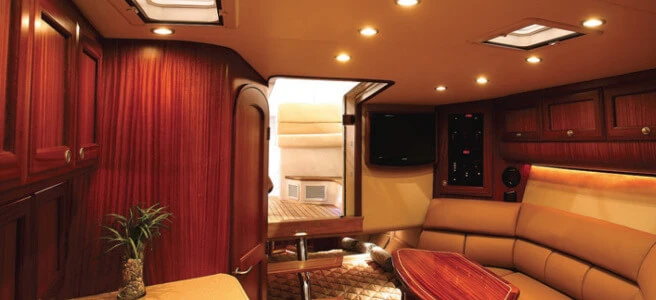
Even if there is nothing faulty with your older lights, there are still reasons to consider the switch. One of the primary values of modern LED lights is that the ratio of light output to energy consumption is much more efficient than older models. LEDs also reduce the heat output compared to many other types of fixtures, including earlier generation LEDs, and they provide a range of light options—neutral, warm, and cool white light.
Beyond the range of different color temperatures and intensities of white light, LED fixtures also have an advantage in their ability to produce multiple colors out of one fixture. This is because the diodes themselves can emit colored light. Halogen and incandescent bulbs require colored lenses in order to produce different colors, and one bulb is incapable of changing colors. LED circuit boards in a fixture or bulb can be arranged with as many differently colored diodes as the physical surface area of the board allows.
All electronics have progressively become more space and energy efficient — using less power, lasting longer, and putting out more light — and LEDs are no exception. Newer LED lights generally produce more light (measured in lumens) and consume less electricity in a smaller, more energy efficient body.
LEDs themselves are also smaller and less clunky than they were in prior generations. As they become smaller and more energy efficient, they produce less warmth, reducing the size of the fixture needed to dissipate that heat, while also outputting more light in a smaller fixture. If you have additional questions about LED lights for boats, be sure to check out Imtra’s Learning Center.
LEDs have brought more sophisticated and affordable lighting concepts to the marine industry, such as “white tuning.” One lightbulb can now be tuned to show warm, neutral or cool light. For example, the Lumishore brand now has all three white light options available in a single downlight as well as full color-changing capabilities. Boat owners can choose the color they want at any time, using a touch screen to pick and choose.
When you’re looking to buy a used boat, consider these problem points that may arise.
The headliner in a cabin can be the biggest challenge when it comes to converting LED lights. If you can’t take it down, or if you have a stretch headliner made of canvas and leather with precut holes for the lights, you may not be able to put it back in place on your own. Sometimes, you may even need to replace the headliner.
On some older boats, you’ll find that the existing lights are set up to use AC power. Most modern LED lights that are intended for boats use low-voltage DC power. So the question we at Imtra ask customers is whether you have a draw that you can pull from — or will you need to install converters from high-voltage AC power to 12 or 24 volt DC power?
Dimmers and switches can also create problems. Halogen and incandescent lights are dimmed through a different process than LEDs, so the dimming switches for the older style lights are almost always incompatible with LED lights. This might require you to replace many of the switches onboard. We dive into more detail on the different processes of dimming in our article on troubleshooting lighting circuits here.
As with any lighting system, depending on the scope and complexity of the installation, LED lighting can be relatively inexpensive, expensive, or somewhere in between. As technology and manufacturing capabilities have advanced, LEDs have become significantly less expensive than they were just a few years ago. But of course, the scope of your refit project will ultimately determine the overall cost.
If you’re simply replacing old halogen bulbs with LED replacement bulbs, it can be a relatively inexpensive fix. Single-color LED bulbs for an interior light fixture typically range in price from $8 – $20 per bulb depending on the size and power of the bulbs. So if you’re replacing the bulbs in 15 interior light fixtures, this can easily be done for $100-$150.
Of course, if you have a larger yacht with dozens or even hundreds of lights and choose to replace entire fixtures, an LED lighting refit can get into the tens of thousands of dollars. Every boat is different, and there are almost always several available options for a refit, ranging from simple bulb replacements to high-tech and color-changing synchronized lighting systems. This is why it’s important to evaluate and weigh your options, and consult with an industry expert.
Have any questions about LED marine lighting, switches, or installation? Be sure to Contact Us and the Imtra team is ready to answer any questions that you may have.
Please sign in to post a comment.
